
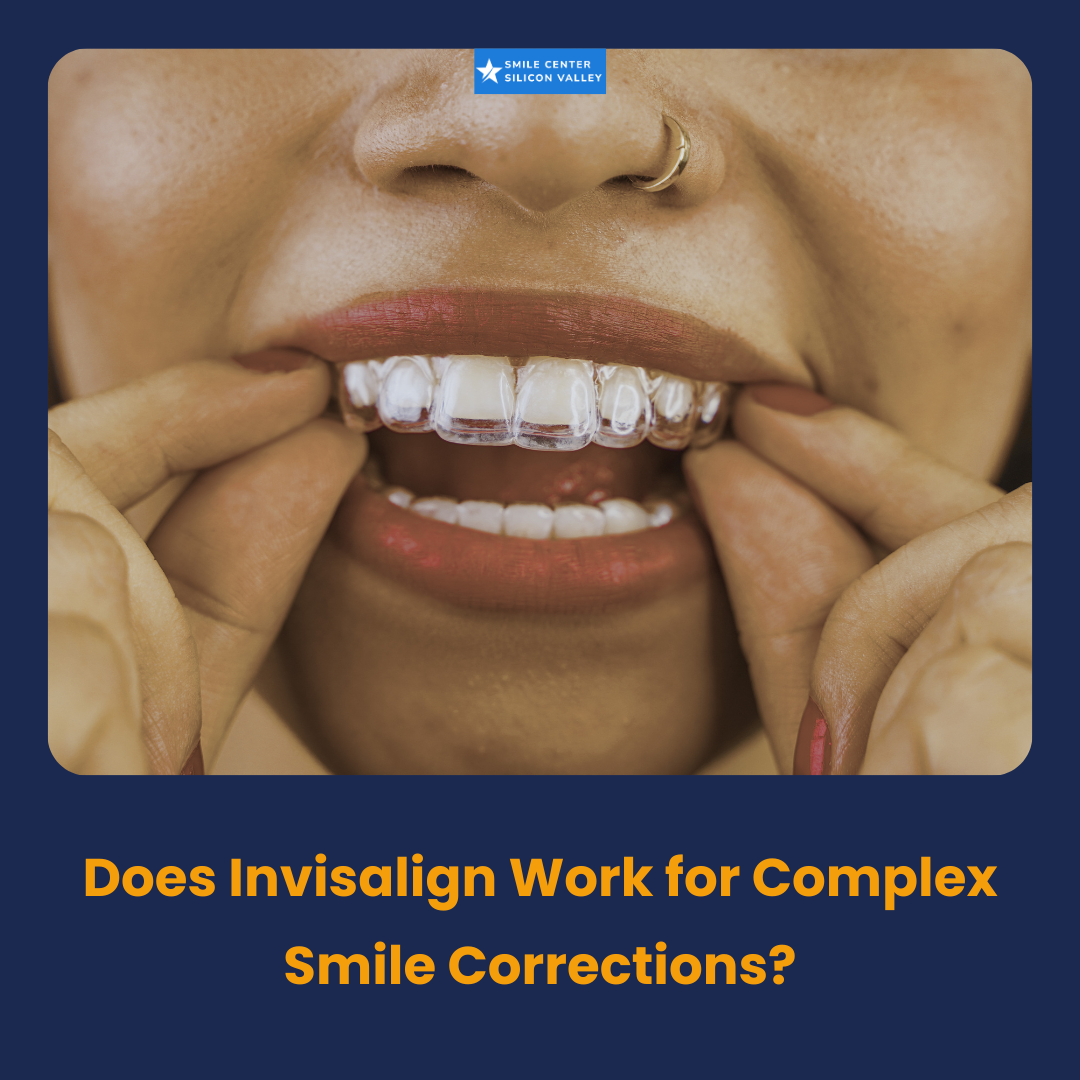
For years, clear aligners were viewed primarily as a superficial cosmetic tool—an aesthetic alternative suited only for fixing minor front-tooth crowding or closing a single small gap. Many patients, and even some traditional practitioners, believed that if a smile required significant structural movement, traditional metal brackets and archwires were the only viable solution.
However, clear aligner technology has undergone a quiet technological revolution. What began as simple thermoformed plastic trays has evolved into a sophisticated, software-driven biomechanical system capable of applying precise, multi-directional force vectors to solve complex orthodontic challenges.
The Silicon Valley Orthodontic Reality
In the fast-paced, high-tech community of Sunnyvale and the greater Silicon Valley area, professionals and busy families demand solutions that combine clinical excellence with minimal impact on daily life. Wearing noticeable metal brackets into corporate meetings, public presentations, or social events is an obstacle many adults prefer to avoid.
Today’s advanced aligner systems allow patients to achieve comprehensive orthodontic corrections discretely. With 3D digital intraoral scanning, algorithmic force modeling, and specialized biomimetic attachments, complex bite issues that once mandated years of metal braces can now be corrected with clear, removable trays—provided the treatment is planned with deep biomechanical expertise.
The Solution Thesis
The truth about clear aligners comes down to a fundamental clinical reality: plastic trays do not move teeth on their own; precise biomechanical planning moves teeth. The aligner is simply the delivery vehicle for force.
When engineered by experienced clinicians utilizing modern digital workflows, clear aligners can successfully treat severe crowding, deep overbites, open bites, crossbites, and significant rotations. By understanding the underlying physics of tooth movement and customizing every stage of treatment, we can deliver predictable, life-changing smile transformations without the inconvenience of fixed metal appliances.
The Biomechanics of Clear Aligners — How Force Vectors Move Teeth
Pushing vs. Pulling: Understanding the Physics
To understand how clear aligners handle complex cases, it helps to examine the fundamental difference in mechanics between traditional braces and clear trays:
- Traditional Brackets: Function primarily through pulling forces. Metal brackets are bonded to the center of each tooth, and a flexible archwire is clipped into place. As the wire attempts to return to its original arch shape, it pulls the teeth along with it, concentrating forces at the bracket location.
- Clear Aligners: Function through pushing forces and elastic deformation. When a custom tray is inserted, it is engineered to be slightly different in shape from the current position of your teeth. As the semi-rigid material seats over the arch, it flexes, storing potential energy that is gradually released as continuous, calibrated pressure pushing specific tooth surfaces into target positions.
SmartForce® Attachments: Handgrips for Enamel
Plastic is inherently smooth, and human tooth enamel is equally slick. Trying to rotate a cylindrical tooth (like a rounded premolar) or pull a tooth down out of the jawbone (extrusion) using smooth plastic alone is like trying to turn a wet doorknob with a smooth glove. This is where modern attachments transform aligner performance.
SmartForce® attachments are small, tooth-colored composite shapes engineered in precise geometric configurations and temporarily bonded to specific teeth. These micro-structures act as custom handles or leverage points. When the clear aligner seats over the attachment, the internal wall of the tray engages the geometric flat edge of the shape, directing force vectors at exact angles deep toward the root. This enables precise control over:
- Root Torque: Tipping or uprighting a tooth’s root deep within the jawbone.
- Extrusion & Intrusion: Moving a tooth vertically in or out of the socket to level a bite.
- Pure Axial Rotation: Turning severe, stubborn rotations that smooth plastic would slide right over.
Staging and Sequencing: Micro-Millimeter Precision
Moving teeth safely requires respecting the biological limits of the periodontal ligament (PDL)—the living tissue complex that anchors your teeth to the surrounding bone. Applying excessive force too quickly can cause root resorption or tissue damage.
Through advanced 3D digital planning tools like ClinCheck® and iTero® high-resolution scanning, every single tooth movement is broken down into micro-stages. Typically, each tray alters tooth position by a maximum of 0.2 to 0.25 millimeters or 1 to 2 degrees of rotation. By sequencing which teeth move first (ancillary anchorage vs. primary movers), clinicians can use stable back teeth as anchors while moving front teeth, or vice versa, resolving complex space requirements step by step.
Complex Orthodontic Cases Invisalign CAN Solve Today
1. Severe Crowding & Arch Expansion
When teeth overlap significantly due to a narrow jaw arch or severe space deficiency, the traditional answer was often permanent tooth extraction. Today, clear aligners can address severe crowding through controlled arch expansion and targeted Interproximal Reduction (IPR).
Aligners can apply uniform, gentle lateral pressure across the entire dental arch, widening the curve of the jaw and creating necessary perimeter space. Where additional space is needed, precise micro-polishing of enamel contact points (IPR) creates fractions of a millimeter between teeth, allowing severely crowded incisors to align smoothly into a harmonious curve.
2. Deep Bites & Anterior Open Bites
Bite alignment (how top and bottom teeth fit together) represents the true test of any orthodontic system:
- Deep Overbites: Occur when upper front teeth overlap lower front teeth excessively, often causing the lower teeth to bite directly into the roof of the mouth. Modern aligners use specialized posterior bite ramps—engineered prompts on the back of upper trays that prevent back teeth from touching while directing intrusive forces onto front teeth, leveling the bite plane effectively.
- Anterior Open Bites: Occur when upper and lower front teeth do not touch when closing, leaving a vertical gap. Aligners excel at correcting open bites by selectively intruding molar teeth in the back while extruding front teeth, effectively rotating the mandible closed without surgery.
3. Severe Rotations & Extraction Cases
A tooth rotated more than 20 degrees off its axis used to be considered off-limits for aligners. With optimized rotation attachments that create twin-force couples (pushing one side forward while pushing the opposite side back), clear trays can now correct rotations up to 45 degrees.
Furthermore, in complex cases requiring premolar extractions to alleviate extreme protrusion, aligners equipped with root-parallel power ridges can guide adjacent teeth straight across extraction gaps without allowing them to tip inward into the open space.
4. Class II & Class III Malocclusions (Overbites & Underbites)
Aligners are no longer isolated to a single arch. By adding precision cuts into the plastic trays, elastic rubber bands can be worn from the upper arch to the lower arch, just as with traditional braces. This allows clinicians to jump bite discrepancies, shifting the relationship of the upper and lower jaw to resolve Class II (overjet) and Class III (underbite) relationships.
When Brackets or Hybrid Biomechanics Are Still Required
The Physical Limits of Removable Plastic
While aligner capabilities have expanded dramatically, clear plastic is still subject to the laws of materials science. Transparency regarding what aligners cannot easily do alone ensures realistic expectations and superior outcomes.
Situations where clear aligners alone may face physical limitations include:
- Severely Impacted Teeth: Teeth trapped deep within the jawbone (such as impacted upper canines) that require surgical exposure and significant mechanical traction.
- Extreme Vertical Root Translation: Moving a completely displaced root several millimeters sideways through dense cortical bone.
- Severe Skeletal Discrepancies: Large jaw size mismatches in fully grown adults that require surgical orthognathic alignment rather than dental tooth movement alone.
The Hybrid Approach: Combining the Best of Both Worlds
Choosing clear aligners does not mean you are locked into an “all-or-nothing” decision. At Smile Center Silicon Valley, we frequently utilize hybrid biomechanics for exceptionally complex cases.
By combining temporary fixed sectional appliances, tooth-colored auxiliary buttons, or Temporary Anchorage Devices (TADs—micro-pins placed in the bone to provide fixed support) with clear aligners, we can execute difficult foundational movements in a few short months before transitioning seamlessly into 100% clear aligner treatment. This hybrid philosophy minimizes the time spent with visible components while delivering flawless structural accuracy.
Clear Aligners vs. Traditional Brackets in Complex Cases
To evaluate how treatment modalities perform across demanding orthodontic parameters, consider this mechanical breakdown:
- Force Vector Precision
- Clear Aligners: 3D digital pre-planning applies force evenly across the entire crown surface using custom attachments.
- Traditional Brackets: Force is concentrated at a single metal point on the tooth crown, relying on manual wire bends.
- Bite Opening Capabilities (Deep Bites)
- Clear Aligners: High efficiency using integrated posterior bite ramps and selective molar intrusion.
- Traditional Brackets: Effective, but often requires cumbersome auxiliary bite turbos or acrylic palate appliances.
- Oral Hygiene & Enamel Health
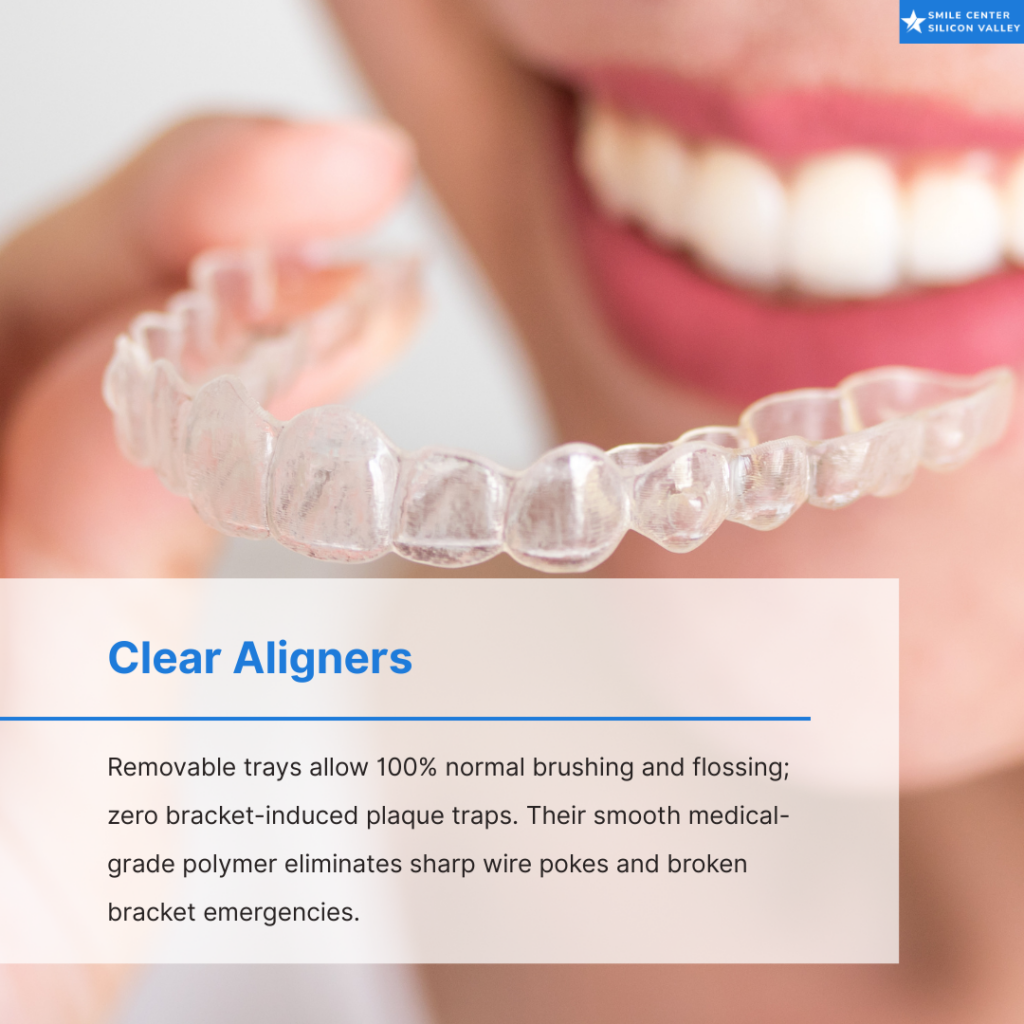
- Clear Aligners: Removable trays allow 100% normal brushing and flossing; zero bracket-induced plaque traps.
- Traditional Brackets: Fixed wires create significant plaque traps, increasing risks of decalcification (white spot lesions).
- Emergency Appointments & Comfort
- Clear Aligners: Smooth medical-grade polymer eliminates sharp wire pokes and broken bracket emergencies.
- Traditional Brackets: Vulnerable to broken archwires, loose brackets, and localized soft-tissue irritation.
- Patient Compliance Requirement
- Clear Aligners: High requirement (must be worn 20–22 hours daily to maintain planned force delivery).
- Traditional Brackets: Fixed in place 24/7; zero dependency on patient memory or compliance.
Orthodontic Q&A
Complex root movement (torque) requires controlling the angle of the root deep inside the jawbone, not just tipping the visible crown. Traditional braces achieve this by twisting rectangular archwires inside square bracket slots. Invisalign accomplishes root movement through custom SmartForce® attachments combined with engineered “Power Ridges” molded directly into the tray plastic. These features press against specific regions of the tooth crown to create a rotational pivot point, forcing the root to move in the desired direction.
Not necessarily. In many complex cases—especially deep bites and arch expansion—clear aligners can actually complete treatment faster or in a similar timeframe to traditional braces. Because aligners move multiple teeth simultaneously according to a pre-programmed digital blueprint, force delivery is extremely continuous and efficient. However, treatment speed depends heavily on wearing the aligners for the required 20 to 22 hours per day.
Precision Digital Orthodontics in Sunnyvale
Clear aligner technology has advanced far beyond simple cosmetic tweaks. Thanks to digital force modeling, SmartForce® attachments, and biomimetic staging, Invisalign works remarkably well for complex smile corrections, including deep bites, open bites, severe crowding, and jaw misalignment. The key to a successful outcome is not the plastic tray itself, but the diagnostic skill, digital planning, and biomechanical expertise of the dental team designing your treatment plan.
Wondering if clear aligners can solve your unique bite or alignment challenges? Skip the guesswork and consult with the advanced digital dentistry team at Smile Center Silicon Valley in Sunnyvale, CA. We utilize high-resolution iTero® 3D scanning and custom biomechanical mapping to show you a virtual simulation of your future smile before treatment even begins.
Contact our Silicon Valley office today to schedule your comprehensive orthodontic evaluation and discover what modern clear aligner mechanics can do for you!